Almandine — NIR2,126 points · 4000–12500 cm⁻¹
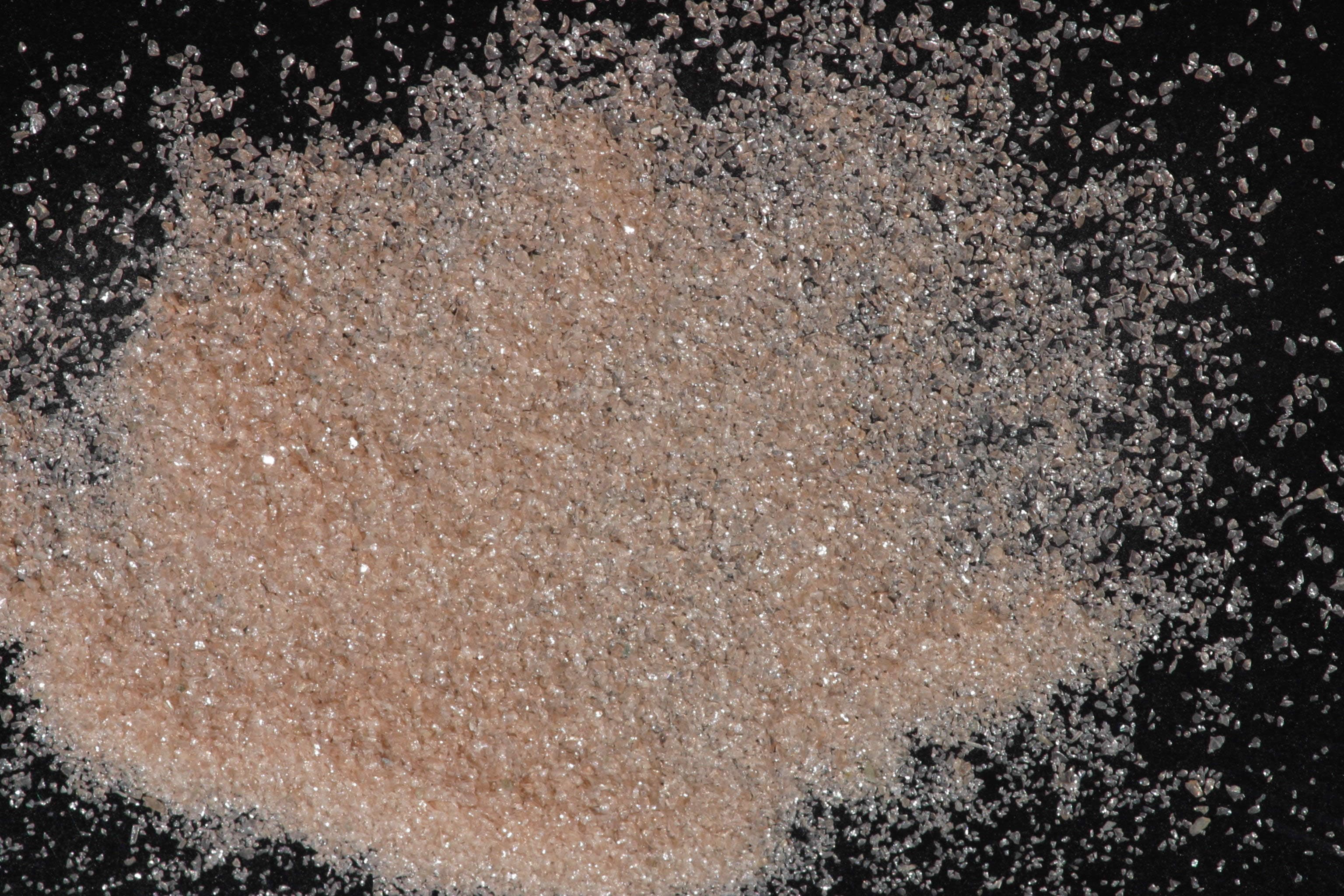
Sample photograph — USGS Spectral Library v7
Spectrum Details
- Modality
- NIR
- Category
- mineral
- Material Type
- Nesosilicate
- Sample ID
- HS114.1B, HS114.2B, HS114.3B, HS114.4B, HS114.6
- Collection Locality
- Warren County, New York
- Spectral Purity
- 1b2_3_4_ # HS114.1B # 1= 0.2-3, 2= 1.5-6, 3= 6-25, 4= 20-150 microns SPECTRAL_PURITY: 1b2_3_4_ # HS114.2B # 1= 0.2-3, 2= 1.5-6, 3= 6-25, 4= 20-150 microns SPECTRAL_PURITY: 1b2b3b4_ # HS114.3B # 1= 0.2-3, 2= 1.5-6, 3= 6-25, 4= 20-150 microns SPECTRAL_PURITY: 1b2_3_4_ # HS114.4B # 1= 0.2-3, 2= 1.5-6, 3= 6-25, 4= 20-150 microns SPECTRAL_PURITY: 1b2_3_4_ # HS114.6 # 1= 0.2-3, 2= 1.5-6, 3= 6-25, 4= 20-150 microns
- Composition / XRD
- EM # XRF, EPMA, ICP(Trace), WChem
- Sample Description
- Forms series with Pyrope and with Spessartine. "This is a common garnet of schists and gneisses and also occurs in intermediate to acidic igneous rocks. It is the most widespread variety of garnet found as a detrital mineral in sedimentary rocks. Again, this spectrum is dominated by the intense absorption at 1.28 µm; and 1.7 µm; due to the ferrous iron in eight-fold coordination. Also, there is a rapid fall off to the blue caused by both ferrous and ferric ion absorptions. The well defined band at 0.7 µm; confirms the presence of Fe^+3 substituted for Al^+3, and the suggestion of a band near 0.85µm; in the smallest particle size is consistent with this - even though the combination of the visible and near-infrared intense absorptions provide a well-resolved maximum near 0.85 µm, especially in the larger particle size samples. The visible spectrum shows features at 0.37, 0.43, 0.51, and 0.57 µm;, which is quite similar to the spectrum of spessartine, with the exception of the very sharp 0.41 µm; Mn^+2 band, which is absent." Hunt, G.R., J.W. Salisbury, and C.J. Lenhoff, 1973, Visible and near-infrared spectra of minerals and rocks: VI. Additional silicates. Modern Geology, v. 4, p. 85-106. Grain size fractions are indicated by the extension after the sample number: .1B = IMAGE_OF_SAMPLE:
- XRD Analysis
- 40 kV - 30 mA, 7.3 -9.5 keV File: alma114.out, *_mdi (smear mount on quartz plate) References: Borg and Smith (1969), JCPDS #9-427, DHZ, v. 1a (1982), Huebner's reference patterns Found: Garnet; very weak un indexed reflection at 2.29 Angstroms Comment: Very sharp reflections indicate excellent crystallinity and suggest compositional homogeneity. Garnet ao=11.51+/-3 Angstroms, consistent with almandine composition (at 11.526 Angstroms). Unusual rise in background centered about 42 degrees 2 theta. J.S. Huebner, J. Pickrell, T. Schaefer, written communication 1994
- X Units
- cm⁻¹
- Y Units
- Absorbance
- Data Points
- 2,126
Download
Attribution
USGS Spectral Library Version 7, U.S. Geological Survey
License: Public Domain
DOI: 10.3133/ds1035Analyze in Workbench
Open this spectrum in the SpectralBench workbench for advanced analysis, peak detection, and comparison.
Open Workbench