Carnallite — NIR2,126 points · 4000–12500 cm⁻¹
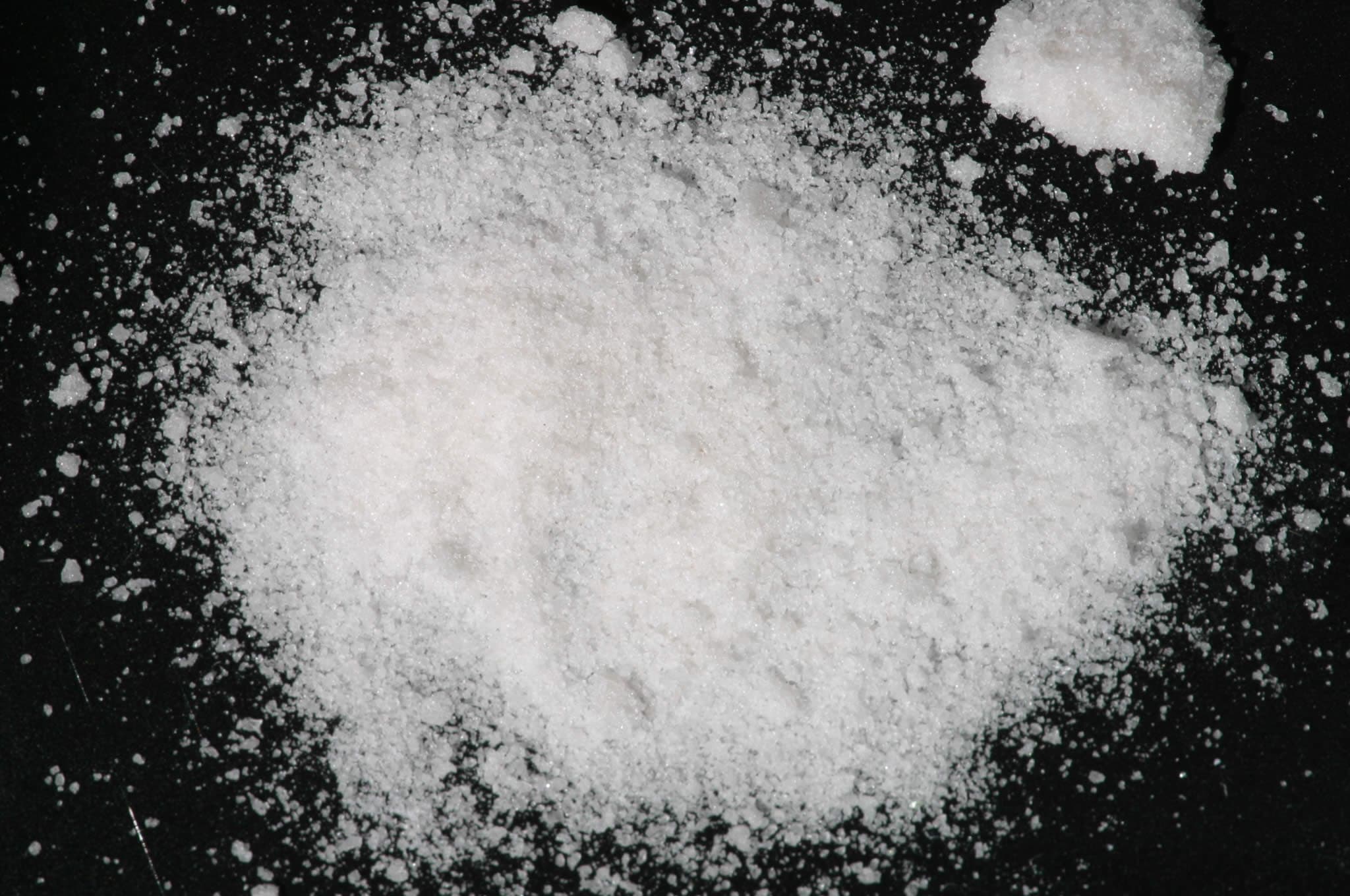
Sample photograph — USGS Spectral Library v7
Spectrum Details
- Modality
- NIR
- Category
- mineral
- Material Type
- Halide
- Sample ID
- HS430.1B, HS430.2B, HS430.3B, HS430.4B, HS430.6
- Collection Locality
- Carlsbad, New Mexico
- Spectral Purity
- 1a2_3_4_ # Carnallite HS430.1B # 1= 0.2-3, 2= 1.5-6, 3= 6-25, 4= 20-150 microns SPECTRAL_PURITY: 1a2_3_4_ # Carnallite HS430.2B # 1= 0.2-3, 2= 1.5-6, 3= 6-25, 4= 20-150 microns SPECTRAL_PURITY: 1a2a3a4_ # Carnallite HS430.3B # 1= 0.2-3, 2= 1.5-6, 3= 6-25, 4= 20-150 microns SPECTRAL_PURITY: 1a2_3_4_ # Carnallite HS430.4B # 1= 0.2-3, 2= 1.5-6, 3= 6-25, 4= 20-150 microns SPECTRAL_PURITY: 1a2_3_4_ # Carnallite HS430.6 # 1= 0.2-3, 2= 1.5-6, 3= 6-25, 4= 20-150 microns
- Composition / XRD
- None # XRF, EPMA, ICP(Trace), WChem
- Sample Description
- This sample was originally described by Hunt and Salisbury as: "H-5. Sylvite. Carlsbad, N.M. (430B). Sylvite, KC1, has the same origin, mode of occurrence and associations as halite, but is much rarer. Like halite, it is colorless when pure, but is more often some shade of red due to ferric oxide inclusions. It may also be yellow or blue, and it has been suggested that the blue coloration is due to F-centers in inclusions of rock salt. This sample is reddish orange, and the absorption less than of 0.55 µ is due to ferric oxide inclusions. The well-defined bands in the near-infrared at 1.0, 1.23, 1.46, 1.77, 1.99, and 2.27 µ are clearly due to water of hydration. Except for a small shift to longer wavelengths these bands are essentially identical with those found in gypsum (see spectra SS-11A, B, C, D, in Part IV). The sylvite obviously contains some hydrated impurity, although it does not appear to be gypsum in this case. Most probably it is magnesium chloride hydrate, but almost any hydrate produces a set of bands similar to those displayed here." Hunt, G.R., J.W. Salisbury, and C.J. Lenhoff, 1972, Visible and near-infrared spectra of minerals and rocks: V. Halides, phosphates, arsenates, vanadates and borates. Modern Geology, v. 3, p. 121-132. XRD has shown this sample to be primarily Carnallite. The visible and near infrared spectral features are from Carnallite. Grain size fractions are indicated by the extension after the sample number: .1B = IMAGE_OF_SAMPLE:
- XRD Analysis
- 45 kV - 35 mA, 6.5-9.5 keV Reference: JCPDS #28-869 Found: Carnallite plus an unidentified reflection at 3.16-3.16 Angstroms. Comments: All strong reflections on the JCPDS card were found. The carnallite reflections are sharp, indicating good crystallinity. The unidentified reflection is broad and may be a doublet. J.S. Huebner, J. Pickrell, and T. Schaefer, 1994, written communication.
- X Units
- cm⁻¹
- Y Units
- Absorbance
- Data Points
- 2,126
Download
Attribution
USGS Spectral Library Version 7, U.S. Geological Survey
License: Public Domain
DOI: 10.3133/ds1035Analyze in Workbench
Open this spectrum in the SpectralBench workbench for advanced analysis, peak detection, and comparison.
Open Workbench