Cellulose SA-C6288 — NIR2,126 points · 4000–12500 cm⁻¹
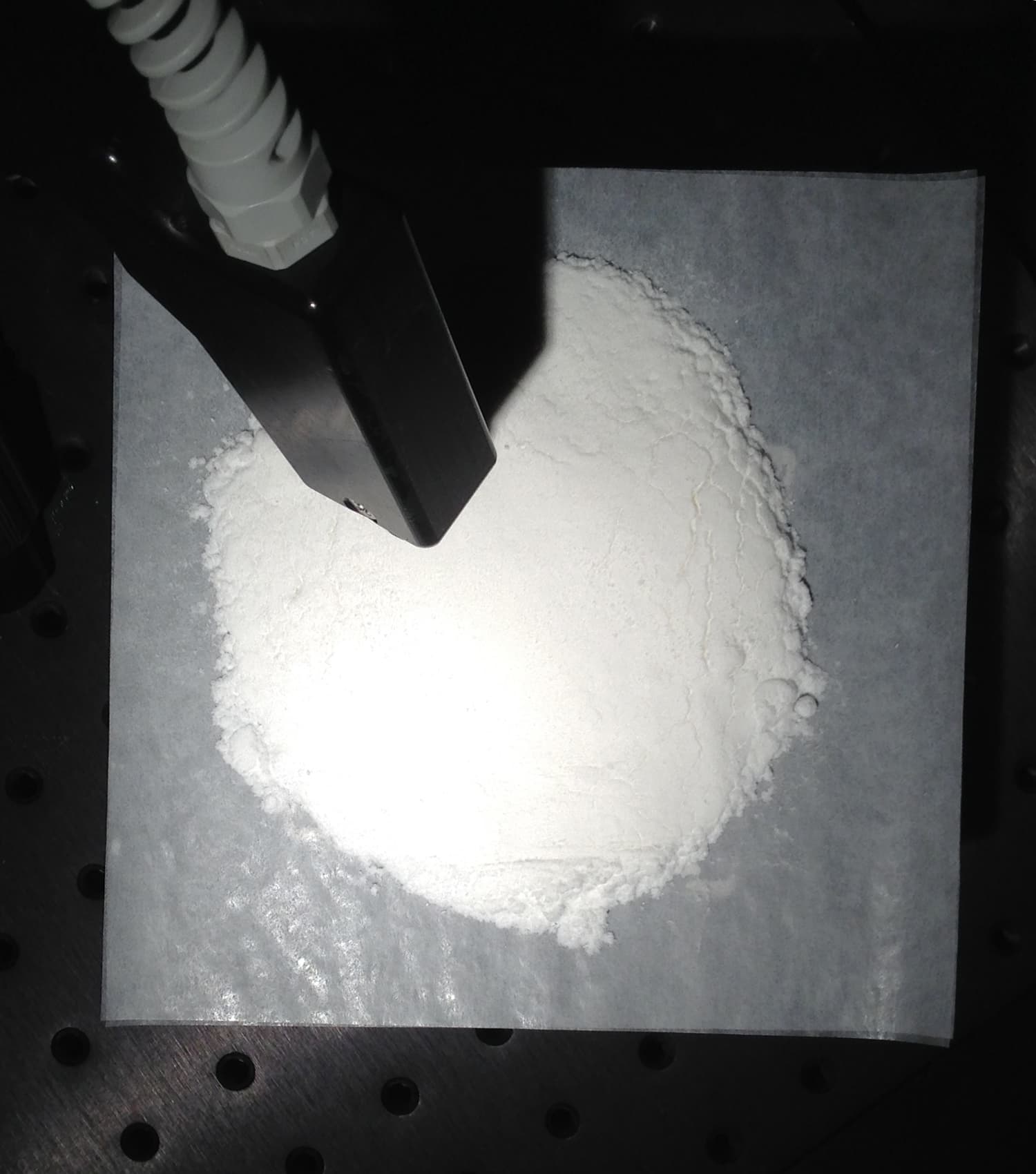
Sample photograph — USGS Spectral Library v7
Spectrum Details
- Modality
- NIR
- Category
- organic
- Material Type
- Sugar; Polysaccharide; Plant Carbohydrate
- Sample ID
- Cellulose SA-C6288
- Collection Locality
- Purchased from Sigma Aldrich chemistry
- Spectral Purity
- 1a2a3_4_ # 1= 0.2-3, 2= 1.5-6, 3= 6-25, 4= 20-150 microns
- Composition / XRD
- Analysis done by Sigma Aldrich, The Certificate of Analysis can be found on the Sigma Aldrich Website using the Product and Lot Numbers.
- Sample Description
- Sample of white powder. Other Names: cellulose CAS #: 9004-34-6 Product #: C6288 Lot #: 043K0042 Cellulose is a polymer of glucose and is the main constituent of plant cell walls. The molecular structure of cellulose is repeating β-d-glucopyranose molecules that are covalently linked through acetal functions between the equatorial OH group of C4 and the C1 carbon atom (β-1,4-glucan). Cellulose is an extensive, linear-chain polymer with a large number of hydroxy groups present in the thermodynamically preferred ^4C1 conformation. The molecular structure imparts cellulose with its characteristic properties: hydrophilicity, chirality, degradability, and broad chemical variability initiated by the high donor reactivity of the OH groups. Cellulose is an end-product of the carbohydrate produced by plant metabolic pathways of photosynthesis, and is considered to be among the most abundant forms of living terrestrial biomass. Cellulose received its name in 1839, following the work of French chemist Anselme Payen who described the resistant fibrous solid remaining after treating plant tissues with acids, ammonia, and solvents In the leaves of plants, cellulose concentrations, on average by dry weight, range from 37% in conifer to 65% in grasses; in the Accelerated Canopy Chemistry Program data set the overall range is from 23% to 74%, (see Kokaly and others 2009). In the seed hairs of cotton, cellulose is available in almost pure form. In contrast, wood cellulose forms a native composite material with lignin and other polysaccharides (hemicelluloses) from which it is isolated by large-scale chemical pulping, separation, and purification processes. This spectrum was used in the following publication: Kokaly, R.F., Asner, G.P., Ollinger, S.V., and Martin, M.E., 2009, Characterizing canopy biochemistry from imaging spectroscopy and its application to ecosystem studies, Remote Sensing of Environment, Volume 113, Pages S78-S91. http://dx.doi.org/10.1016/j.rse.2008.10.018 IMAGE_OF_SAMPLE:
- X Units
- cm⁻¹
- Y Units
- Absorbance
- Data Points
- 2,126
Download
Attribution
USGS Spectral Library Version 7, U.S. Geological Survey
License: Public Domain
DOI: 10.3133/ds1035Analyze in Workbench
Open this spectrum in the SpectralBench workbench for advanced analysis, peak detection, and comparison.
Open Workbench