Clinochlore — NIR2,126 points · 4000–12500 cm⁻¹
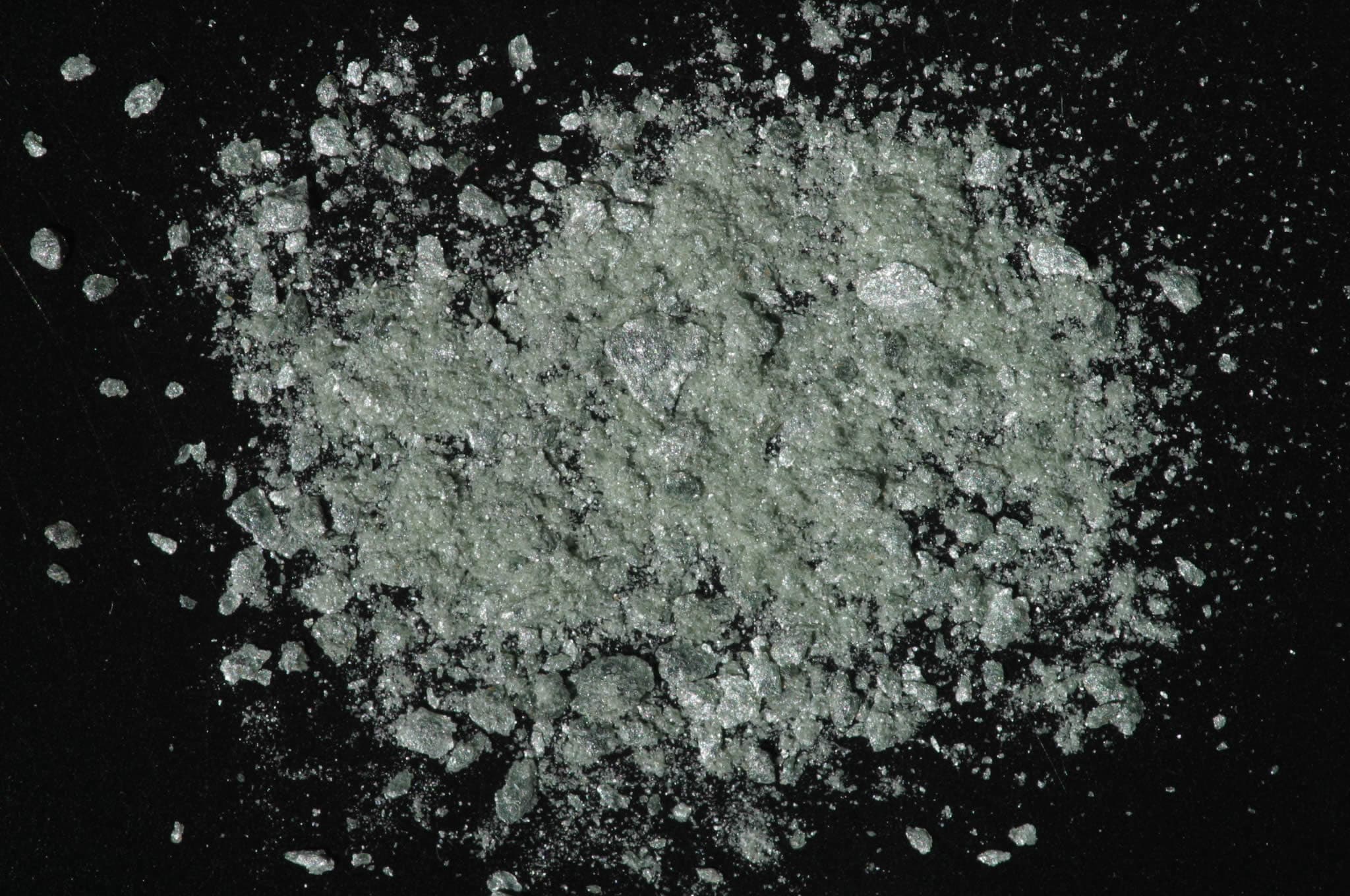
Sample photograph — USGS Spectral Library v7
Spectrum Details
- Modality
- NIR
- Category
- mineral
- Material Type
- Phyllosilicate
- Sample ID
- GDS158
- Collection Locality
- Flagstaff Hill, California ORIGINAL_DONOR: Jim Post CURRENT_SAMPLE_LOCATION: USGS Denver Spectroscopy Laboratory ULTIMATE_SAMPLE_LOCATION: USGS Denver Spectroscopy Laboratory SAMPLE_DESCRIPTION:
- Spectral Purity
- 1b2b3b4_ # 1= 0.2-3, 2= 1.5-6, 3= 6-25, 4= 20-150 microns
- Composition / XRD
- None # XRF, EPMA, ICP(Trace), WChem
- Sample Description
- This sample described in: Post, J.L. and C.C. Plummer, 1972, The chlorite series of Flagstaff Hill area, California: A preliminary investigation. Clays and Clay Minerals, v.20, pp271-283. Clinochlore was previously called Sheridanite. IMAGE_OF_SAMPLE:
- XRD Analysis
- 45 kV - 35 mA, 6.5-9.5 keV, smear mount (sherd8.out); 40 kV - 30 mA, random mount (sherd8-2.out) References: Bailey (1988, MSA Reviews 19; 1988 in Clays and Clay Minerals); Huebner's reference patterns Found: Chlorite type IIbb. A broad, very weak reflection at 9.6 is probably due to a trace of mica. A weak reflection at 3.23 Angstroms may be due to a trace of feldspar. A weak unidentified reflection at 2.357 Angstroms. And a weak, unidentified reflection at 7.8 Angstroms that also appeared in GDS157 (the "ripidolite"). Sought but not found: quartz Comments: With chemical analysis, the chlorite is a clinochlore IIbb. Severe preferred orientation in smear mounts; fortunately, there was enough sample for a random mount. Sharp chlorite reflections indicate excellent crystallinity. With GDS157 ("ripidolite"), the best chlorite patterns I have ever seen." J.S. Huebner, J. Pickrell, and T.Schaefer, 1994, written communication. 40 kV- 30 mA, 7.3-9.5 keV File sherd158.out, -.mdi (edge/random mount) References: Bailey (1988 in Clays and Clay Minerals, 36, 193-213); Huebner's reference patterns Found: clinochlore type IIbb, trace rutile Comment: Sharp reflections suggest excellent crystallinity and compositional homogeneity. Position of the (060) reflection indicates Mg/(Mg+Fe+Mn) = 0.85. Presence of rutile confirmed optically; rutile forms thin but very elongate needles in the chlorite flakes ("rutilated clinochlore").
- X Units
- cm⁻¹
- Y Units
- Absorbance
- Data Points
- 2,126
Download
Attribution
USGS Spectral Library Version 7, U.S. Geological Survey
License: Public Domain
DOI: 10.3133/ds1035Analyze in Workbench
Open this spectrum in the SpectralBench workbench for advanced analysis, peak detection, and comparison.
Open Workbench