Copiapite — FTIR1,801 points · 400–4000 cm⁻¹
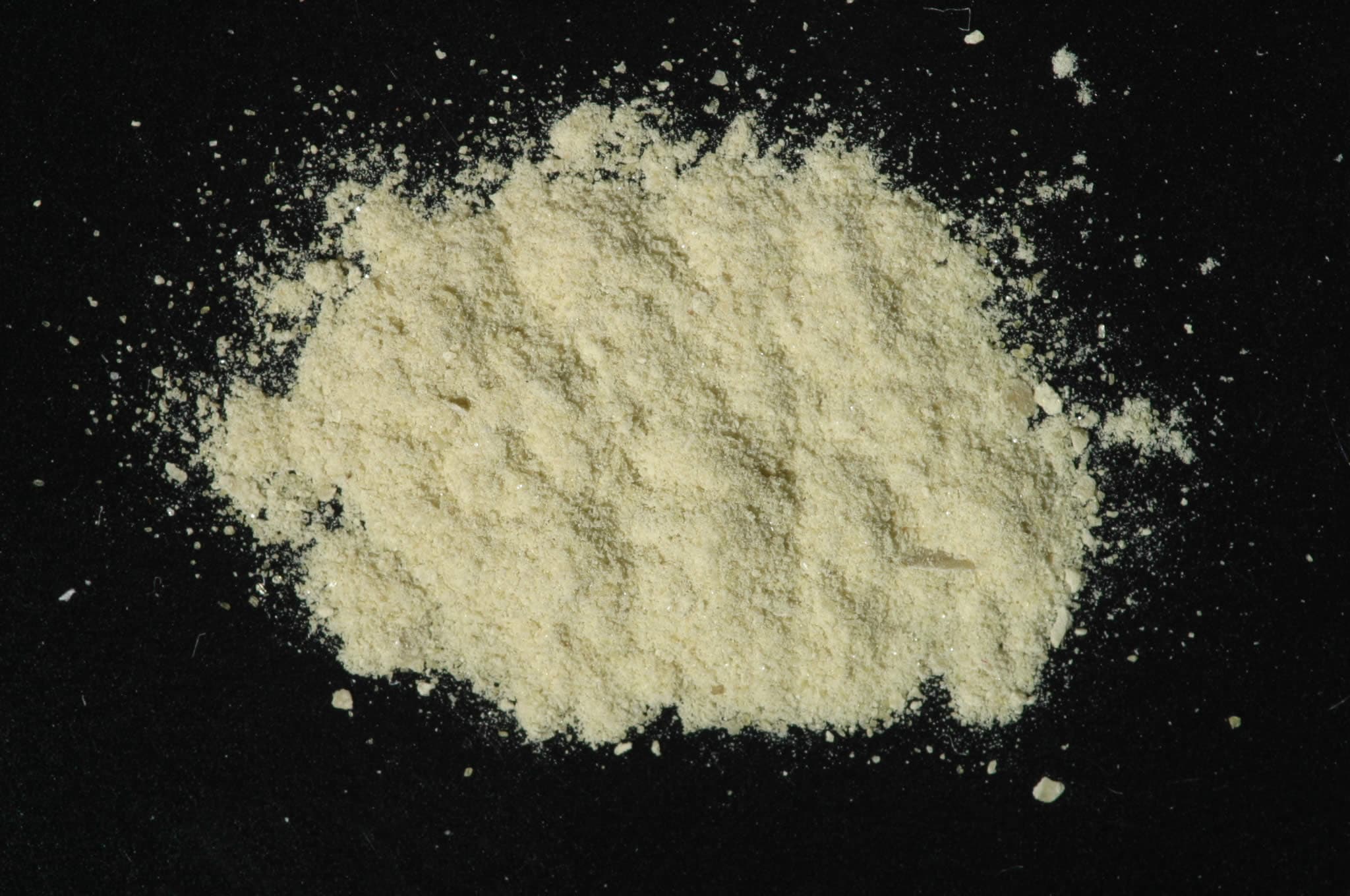
Sample photograph — USGS Spectral Library v7
Spectrum Details
- Modality
- FTIR
- Category
- mineral
- Material Type
- Sulfate
- Sample ID
- GDS21
- Collection Locality
- Cyprus
- Spectral Purity
- 1b2b3c4_ # 1= 0.2-3, 2= 1.5-6, 3= 6-25, 4= 20-150 microns
- Composition / XRD
- None # XRF, EPMA, ICP(Trace), WChem
- Sample Description
- IMAGE_OF_SAMPLE:
- XRD Analysis
- 40 kV - 30 mA, 6.5-9.5 keV (smear mount on quartz, copiapit.out); 40 kV - 30 mA, 7.3-9.5 keV (slurry onto quartz plate, copiapt2.out) References: JCPDS #35-583, 29-714, 20-659, 19-394, 33-1472, 42-599, 27-77 Found: two members of the copiapite group; perhaps at least one additional phase Comment: The original pattern (copiapit.out) was barren above 30 degrees; a second pattern showed little above 38 degrees but the strip chart revealed that some reflections at low 2 theta are doublets, indicating the presence of two phases having related structures. The intensity ratio is about 5:2. There are seven mineral species in the copiapite group. I have not succeeded in completely indexing the pattern, using the JCPDS data, so I don't know which copiapite species (or solid solutions) are present. EDA analysis (on the SEM) shows a aluminum and silicon in addition Fe, S, and O. This results could indicate that one of the copiapites is Al-rich. Also that a trace of quartz is present (there are what I call insignificant peaks at the positions of the strong quartz (100) and (101) reflections - insignificant because they could just as likely be background noise. A hand-specimen with crystals suitable for single- crystal X-ray diffraction would help us sort out the copiapite species present." J.S. Huebner, J. Pickrell, and T. Schaefer, 1994, written communication.
- X Units
- cm⁻¹
- Y Units
- Absorbance
- Data Points
- 1,801
Download
Attribution
USGS Spectral Library Version 7, U.S. Geological Survey
License: Public Domain
DOI: 10.3133/ds1035Analyze in Workbench
Open this spectrum in the SpectralBench workbench for advanced analysis, peak detection, and comparison.
Open Workbench