Ilmenite — FTIR1,801 points · 400–4000 cm⁻¹
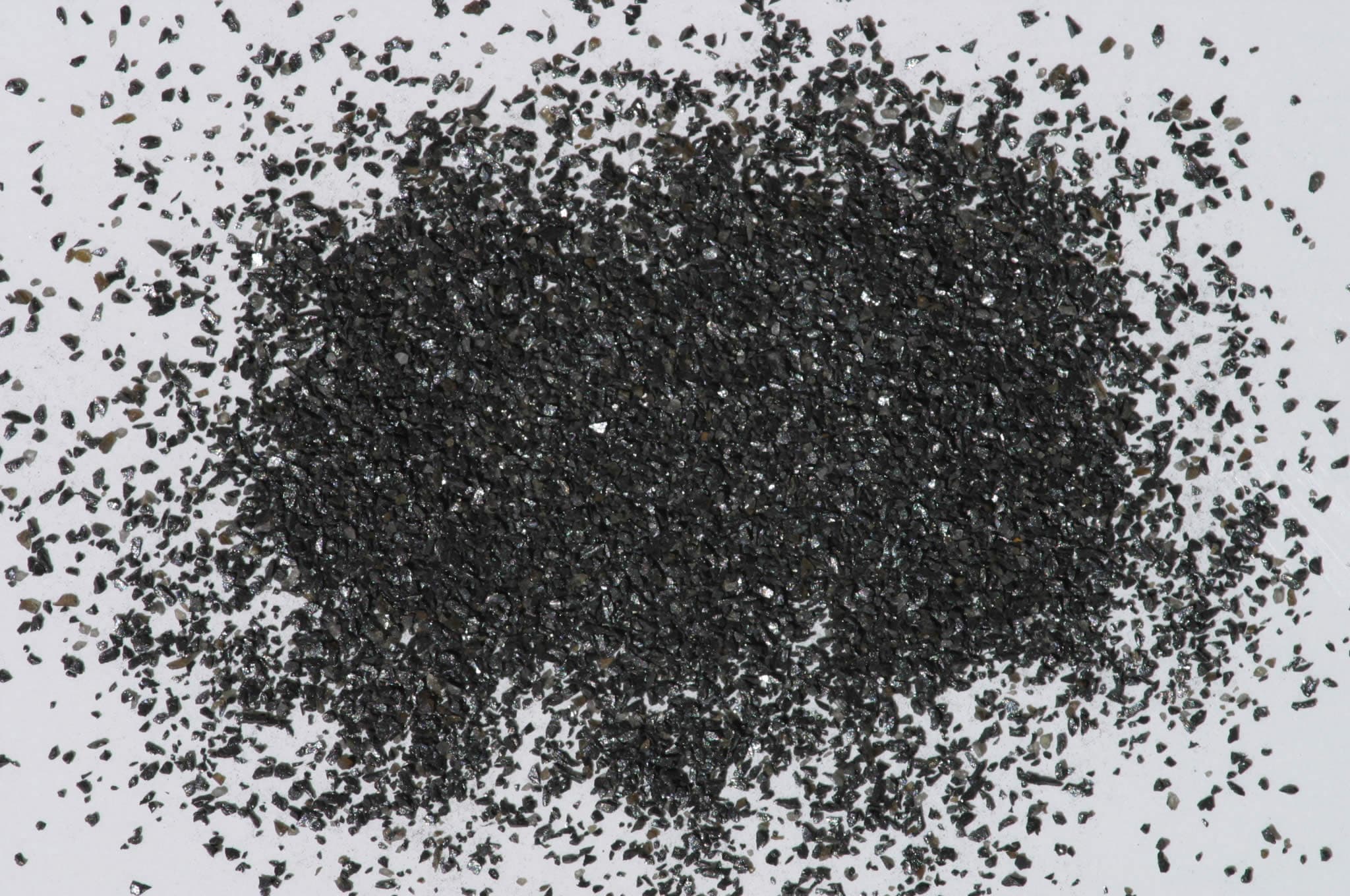
Sample photograph — USGS Spectral Library v7
Spectrum Details
- Modality
- FTIR
- Category
- mineral
- Material Type
- Oxide
- Sample ID
- HS231.2B, HS231.3B, HS231.4B
- Collection Locality
- Norway
- Spectral Purity
- 1b2_3_4_ # Ilmenite HS231.2B # 1= 0.2-3, 2= 1.5-6, 3= 6-25, 4= 20-150 microns SPECTRAL_PURITY: 1b2b3c4u # Ilmenite HS231.3B # 1= 0.2-3, 2= 1.5-6, 3= 6-25, 4= 20-150 microns SPECTRAL_PURITY: 1b2_3_4_ # Ilmenite HS231.4B # 1= 0.2-3, 2= 1.5-6, 3= 6-25, 4= 20-150 microns
- Composition / XRD
- None # XRF, EPMA, ICP(Trace), WChem COMPOSITION_TRACE:
- Sample Description
- Forms series with Geikielite. "O-10. Ilmenite. Norway (231B). Ilmenite, FeTiO3, is sometimes found in veins or large masses as a product of magmatic segregation, and as beds or lenses in metamorphic rocks. Most commonly, it is an accessory mineral in igneous rocks, and it is frequently associated with the heavy fraction of beach and river sands. As in the case of this sample, ilmenite is typically an opaque, almost spectrally featureless mineral in the visible and near-infrared. The relative reflectivity of the various particle sizes is typical of an opaque mineral--i.e., the smaller the particle size, the lower the reflectivity. Pure ilmenite is considered to be a titanate of ferrous iron (Fe^2+ Ti^4+O3) rather than a double sesquioxide of ferric iron and titanium (Fe^3+ Ti^3+ O3). In ilmenite ferric oxide is often present and can introduce features typical of the Fe^3+ ion. When as little as 1% Ti is substituted in Fe2O3, the titanium acts as a donor and is all ionized to Ti^4+ and Fe^2+, and the Fe^2+ produces a broad feature centered near 1.5µ. We have already observed a broad feature centered near 1.8µ in the pyroxenes (see Part I) which was attributed to the Fe^2+ ion in a disordered octahedral site. The hydrated titanium ion (Ti^3+ 6H2O) produces a very broad spectral feature extending from 0.5µ into the infrared with a maximum at 2.0µ. The overall opacity of ilmenite is probably caused by a combination of all these features, broadened by defects, edge effects and the presence of impurities, as well as conduction bands due to both the iron and titanium extending out from the ultraviolet into the visible." Hunt, G.R., J.W. Salisbury, and C.J. Lenhoff, 1971, Visible and near-infrared spectra of minerals and rocks: III. Oxides and hydroxides. Modern Geology, v. 2, p. 195-205. Grain size fractions are indicated by the extension after the sample number: .2B = IMAGE_OF_SAMPLE:
- XRD Analysis
- 40 kV - 30 mA, 7.3-9.5 keV Files: ilmnt231.out, -.mdi, ground once; ilm231-2_*, ground twice; ilm231-3.*, same material as ilmnt231 References: JCDPS 29-733 (ilmenite) and 24-0074 (hematite); Huebner's reference patterns; SEM X-ray spectroscopy; light optical microscopy Found: ilmenite, minor hematite and orthopyroxene, trace muscovite. Also weak unidentified reflections at 4.06, 2.94, 2.101, 2.028, 1.70, 1.44, and 1.395 Angstroms Sought but not found: Quartz Comment: Very well crystallized ilmenite and hematite. Observed hematite as exsolution lamellae in ilmenite using BSE imaging. Minor phases can fractionate from dense oxides during sample preparation, so their peak intensities are variable. J.S. Huebner, J. Pickrell, T. Schaefer, written communication 1994
- X Units
- cm⁻¹
- Y Units
- Absorbance
- Data Points
- 1,801
Download
Attribution
USGS Spectral Library Version 7, U.S. Geological Survey
License: Public Domain
DOI: 10.3133/ds1035Analyze in Workbench
Open this spectrum in the SpectralBench workbench for advanced analysis, peak detection, and comparison.
Open Workbench