Opal — FTIR1,801 points · 400–4000 cm⁻¹
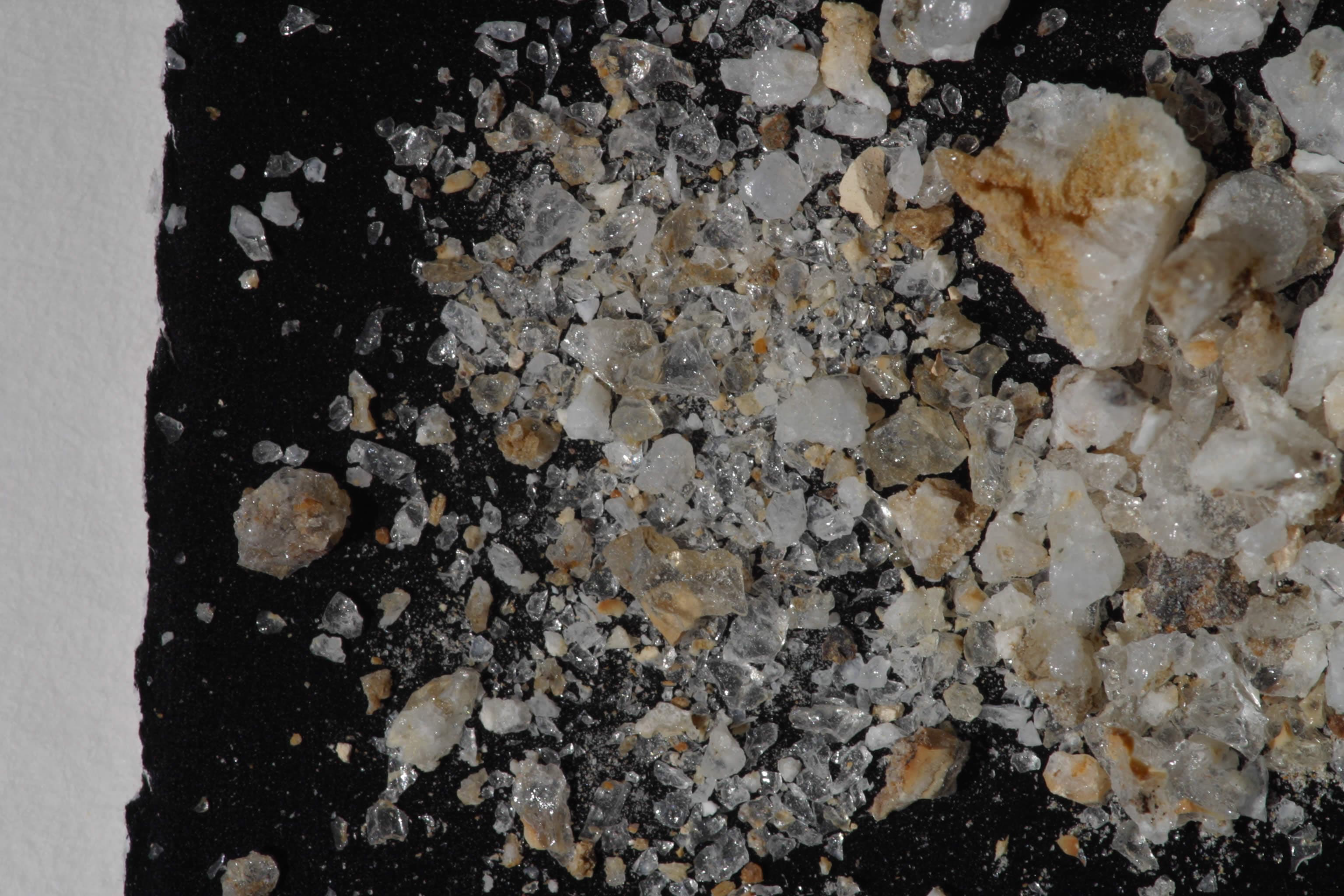
Sample photograph — USGS Spectral Library v7
Spectrum Details
- Modality
- FTIR
- Category
- mineral
- Material Type
- Tectosilicate
- Sample ID
- TM8896
- Collection Locality
- Beaver Co., UT.
- Spectral Purity
- 1a2a3a4_ # TM8896 # 1= 0.2-3, 2= 1.5-6, 3= 6-25, 4= 20-150 microns
- Composition / XRD
- None # XRF, EPMA, ICP(Trace), WChem COMPOSITION_TRACE: None
- Sample Description
- IMAGE_OF_SAMPLE: photo of bulk sample
- XRD Analysis
- 40 kV - 30 mA, 6.5-9.5 keV References: Tada and Iijima (1983), Isaacs and others (1983) Found: mixture of opal-A and opal-CT Comment: A good opal. Broad maximum centered at 22 degrees, very poor degree of crystallinity. Opal-CT has a very weak reflection at position of quartz (101). I have no basis for estimating the relative proportions of these the two forms of opal - rather, they form a progression as longer-range order develops. J.S. Huebner, J Pickrell, T. Schaefer, unpublished data, written communication, USGS, Reston, VA (1994) 40 kV - 30 mA, 6.5-9.5 keV File: opal8896.mdi (smear on quartz plate) References: Isaacs and others (1983); Tada and Ijima (1983) Found: opaline phase Comment: There is only one very weak and broad peak, in the position of the usually intense and sharp quartz (101) reflection at 3.35 Angstroms. The observed broad rise centered around 4.00 Angstroms is consistent with opaline silica. Possibly significant maxima on the broad rise are in positions of cristobalite and tridymite, but there are no corresponding peaks at smaller interplanar spacing's. The material is most likely transitional between opal-A and opal-CT states.
- X Units
- cm⁻¹
- Y Units
- Absorbance
- Data Points
- 1,801
Download
Attribution
USGS Spectral Library Version 7, U.S. Geological Survey
License: Public Domain
DOI: 10.3133/ds1035Analyze in Workbench
Open this spectrum in the SpectralBench workbench for advanced analysis, peak detection, and comparison.
Open Workbench