Paragonite — NIR2,126 points · 4000–12500 cm⁻¹
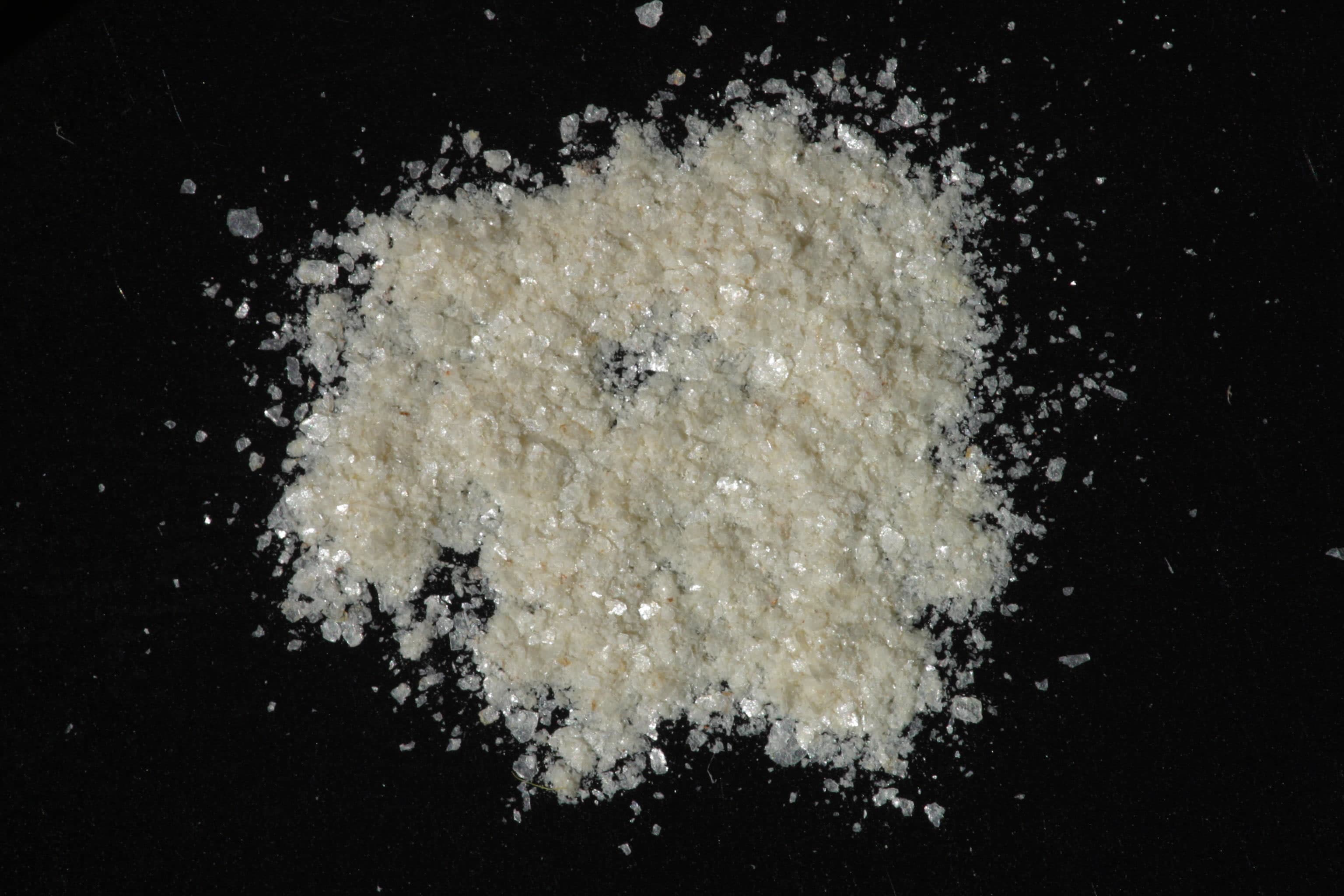
Sample photograph — USGS Spectral Library v7
Spectrum Details
- Modality
- NIR
- Category
- mineral
- Material Type
- Phyllosilicate
- Sample ID
- GDS109
- Collection Locality
- Ilas de Margarita, Venezuela
- Spectral Purity
- 1a2_3_4_ # GDS109 # 1= 0.2-3, 2= 1.5-6, 3= 6-25, 4= 20-150 microns
- Composition / XRD
- see discussion # XRF, EPMA, ICP(Trace), WChem
- Sample Description
- see: Robie, R.A., and B.S. Hemingway, 1984, Heat capacities and entropies of phlogopite and paragonite between 5 and 900 K and estimates of the enthalpies and Gibbs free energies of formation. American Mineralogist, v.69, pp. 858-868. IMAGE_OF_SAMPLE:
- XRD Analysis
- 40 kV - 30 mA, 6.5-9.5 keV (smear mount of GDS109 = parag.out; smear mount of GDS109 ground with glass = parag2.out) References: Bailey (1988, p. 201); calculated 2M1 paragonite pattern of Borg and Smith (1969); Huebner's reference patterns Found: dioctahedral mica Sought but not found: quartz, muscovite, chlorite Comments: Many expected reflections were not resolved, even following grinding with glass; non-basal reflections are broad. The position of the (004) reflection indicates the presence of a small cation such as sodium. The polytype could not be determined. Even allowing for preferred basal orientation, GDS109 is poorly crystallized. It is not of the same quality as the "muscovites" and probably should not be compared with them to attempt to ascertain K/Na from spectra. However, poorly crystallized material such as GDS109 may be more representative of micas in sedimentary environments than is the suite of "muscovites". J.S. Huebner, J. Pickrell, and T. Schaefer, 1994, written communication. "Unit cell parameters are a = 0.5130±0.0010 nm, b = 0.8905±0.0017 nm, c = 1.9342±:0.0039 nm, and beta = 94.50.2° and the structure type is 2M1 (M.R. Ross, written communication, August 1982). These parameters are in good agreement with those reported by Chatterjee (1974) and Holland (1979) for synthetic 2M1 paragonite." Robie, R.A., and B.S. Hemingway, 1984, Heat capacities and entropies of phlogopite and paragonite between 5 and 900 K and estimates of the enthalpies and Gibbs free energies of formation. American Mineralogist, v.69, pp. 858-868.
- X Units
- cm⁻¹
- Y Units
- Absorbance
- Data Points
- 2,126
Download
Attribution
USGS Spectral Library Version 7, U.S. Geological Survey
License: Public Domain
DOI: 10.3133/ds1035Analyze in Workbench
Open this spectrum in the SpectralBench workbench for advanced analysis, peak detection, and comparison.
Open Workbench