Protein soy powder NC2 — NIR2,126 points · 4000–12500 cm⁻¹
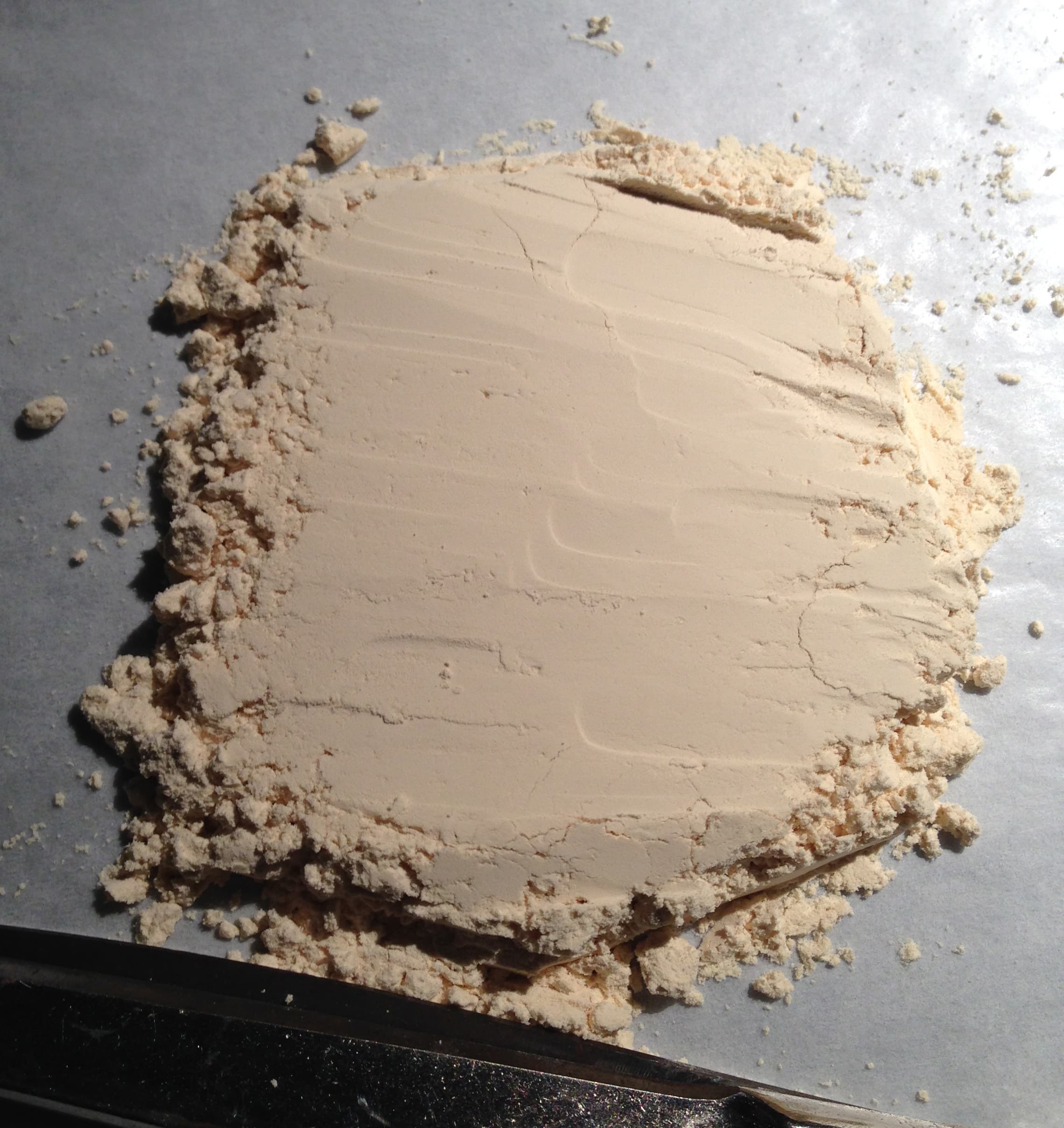
Sample photograph — USGS Spectral Library v7
Spectrum Details
- Modality
- NIR
- Category
- organic
- Material Type
- Protein; Amino acid polymer; Plant biochemical component
- Sample ID
- Protein, soy, powder NC2
- Collection Locality
- Purchased from nutrient supplement store.
- Spectral Purity
- 1a2a3_4_ # 1= 0.2-3, 2= 1.5-6, 3= 6-25, 4= 20-150 microns
- Composition / XRD
- Analysis done by Sigma Aldrich, The Certificate of Analysis can be found on the Sigma Aldrich Website using the Product and Lot Numbers.
- Sample Description
- Sample of tan powder. Other Names: protein This protein sample was purchased as a nutritional supplement from a health food store. The manufacturer was NOW Foods corporation (Bloomingdale, Illinois). Proteins are the major,nitrogen-containing biochemical constituent of plants. Proteins are large biological molecules consisting of one or more chains of amino acids; where the amino acids are linked by amide bonds (peptide bonds) between the N (nitrogen) in the amine portion (-NH2) of one amino acid and the C (carbon) in the carboxylic acid portion (-COOH) of another amino acid. Proteins differ from one another primarily in their sequence of amino acids, which is dictated by the nucleotide sequence of their genes. The different sequence of acids results in folding of the protein into a specific three-dimensional structure that determines its activity. One protein, ribulose-1,5-biphosphate carboxylase-oxygenase (rubisco) accounts for 30�50% of the N in green leaves, where it is found in high concentration in the stroma of chloroplasts. Because of its abundance in plants, rubisco is considered the most plentiful protein on the planet. Rubisco is the principal CO2-fixing enzyme in C3 plants and the ultimate CO2-fixing enzyme in C4 and CAM (crassulacean acid metabolism) plants. Roughly 70% of leaf N is tied up in molecules that support carbon fixation. Among other absorption features, proteins have two absorption features centered near 2.055 and 2.172 microns that are situated on the shoulders of the dry leaf 2.1 micron absorption feature. These protein absorptions arise from vibrations of N-containing amide bonds that form the backbone of the protein structure and are repeated along the length of each molecule. These protein absorptions are offset from the more centrally located absorptions of lignin and cellulose at 2.102 and 2.144 microns, respectively, accentuating the influence of this biochemical constituent so that it has an observable impact on reflectance spectra (see Kokaly 2001). For this reason, nitrogen, despite being a small component by leaf weight, is successfully estimated from reflectance measurements of leaves and canopies. This spectrum has been used in the following publications: Kokaly, R.F., 2001, Investigating a Physical Basis for Spectroscopic Estimates of Leaf Nitrogen Concentration, Remote Sensing of Environment, Volume 75, Pages 153-161. http://dx.doi.org/10.1016/S0034-4257(00)00163-2 Kokaly, R.F., Asner, G.P., Ollinger, S.V., and Martin, M.E., 2009, Characterizing canopy biochemistry from imaging spectroscopy and its application to ecosystem studies, Remote Sensing of Environment, Volume 113, Pages S78-S91. http://dx.doi.org/10.1016/j.rse.2008.10.018 IMAGE_OF_SAMPLE:
- X Units
- cm⁻¹
- Y Units
- Absorbance
- Data Points
- 2,126
Download
Attribution
USGS Spectral Library Version 7, U.S. Geological Survey
License: Public Domain
DOI: 10.3133/ds1035Analyze in Workbench
Open this spectrum in the SpectralBench workbench for advanced analysis, peak detection, and comparison.
Open Workbench