Spessartine — NIR2,126 points · 4000–12500 cm⁻¹
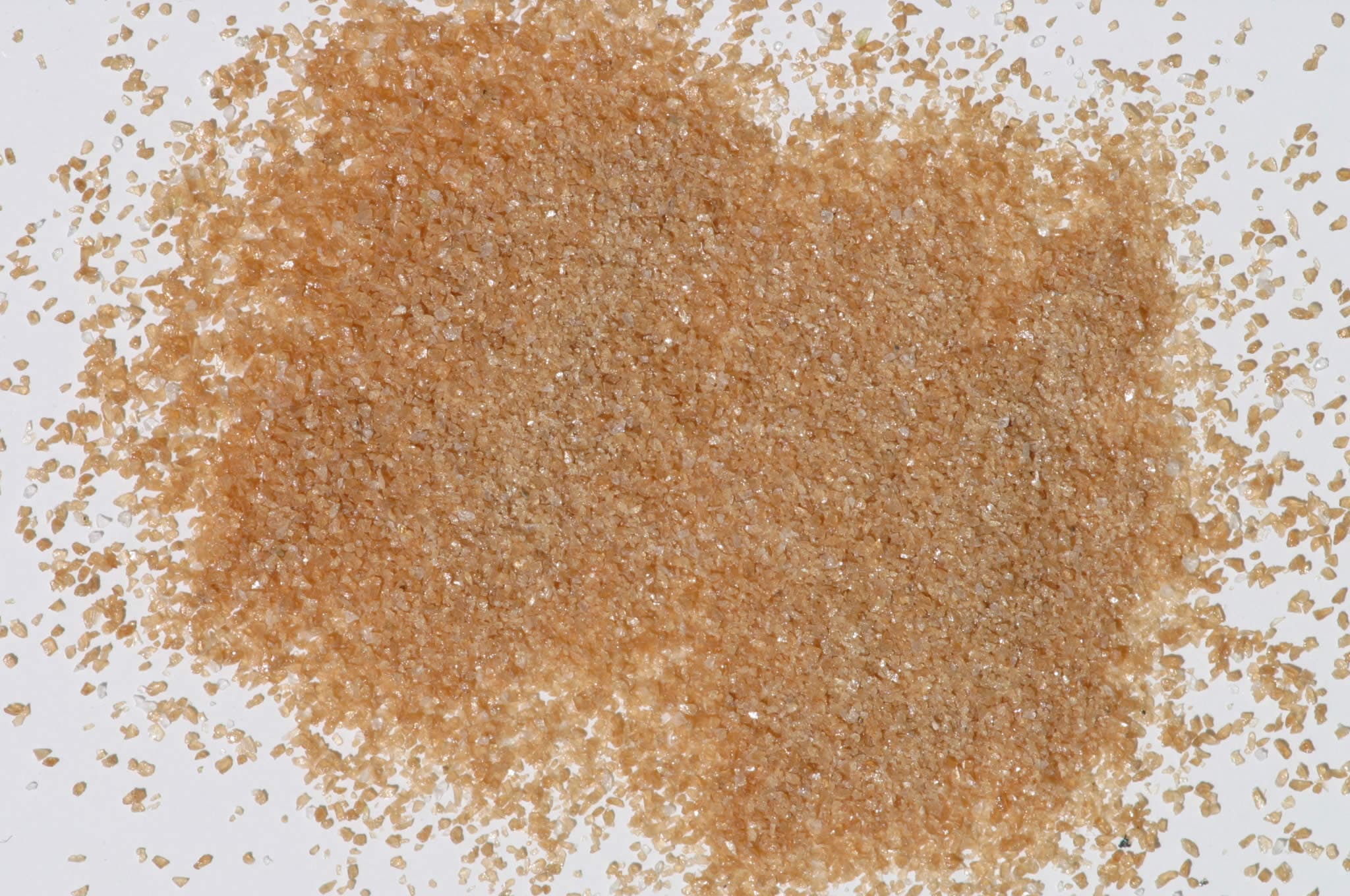
Sample photograph — USGS Spectral Library v7
Spectrum Details
- Modality
- NIR
- Category
- mineral
- Material Type
- Nesosilicate
- Sample ID
- HS112.3B
- Collection Locality
- Haddon, Connecticut
- Spectral Purity
- 1b2c3c4_ # HS112.3B # 1= 0.2-3, 2= 1.5-6, 3= 6-25, 4= 20-150 microns
- Composition / XRD
- None # XRF, EPMA, ICP(Trace), WChem COMPOSITION_TRACE:
- Sample Description
- Forms series with Almandine. "Spessartite 112B--Haddon, Conn. Mn3Al2(SiO4)3: Spessartite is less common than many garnets, occurring primarily in metamorphic rocks and granite pegmatites. The dominant features in the spectrum are the intense bands at 1.275 and 1.7 µ due to the presence of ferrous iron in eight-fold coordination, as discussed above. The visible spectrum falls off sharply to the blue producing a maximum near 0.8 µ. In the larger particle sizes this feature shows a shoulder near 0.9 µ, indicating the presence of Fe^3+. While the visible spectrum displays the very sharp feature at 0.41 µ characteristic of Mn^2+ absorption, the rest of its usually distinctive spectrum is degraded by the presence of absorptions by both Fe^3+ and Fe^2+. Together these 3 ions can account for the bands at 0.37, 0.43 µ, the broad general absorption centered near 0.55 µ, and the fall off to the blue." Hunt, G.R., J.W. Salisbury, and C.J. Lenhoff, 1973, Visible and near-infrared spectra of minerals and rocks: VI. Additional silicates. Modern Geology, v. 4, p. 85-106. IMAGE_OF_SAMPLE:
- XRD Analysis
- 40 kV - 30 mA, 6.7-9.5 keV File: spes112.mdi References: Huebner's reference patterns Found: Garnet, minor quartz Comments: Garnet peaks are moderately sharp. Resolution of the alpha1-alpha2 components is not as good as might be expected from the sharpness, and slight shoulders extend toward larger d-spacings, suggesting that slight compositional zoning may be present. The cell dimension of the garnet is 11.65 Angstroms, consistent with a spessartine-rich garnet.
- X Units
- cm⁻¹
- Y Units
- Absorbance
- Data Points
- 2,126
Download
Attribution
USGS Spectral Library Version 7, U.S. Geological Survey
License: Public Domain
DOI: 10.3133/ds1035Analyze in Workbench
Open this spectrum in the SpectralBench workbench for advanced analysis, peak detection, and comparison.
Open Workbench