Vermiculite — NIR2,126 points · 4000–12500 cm⁻¹
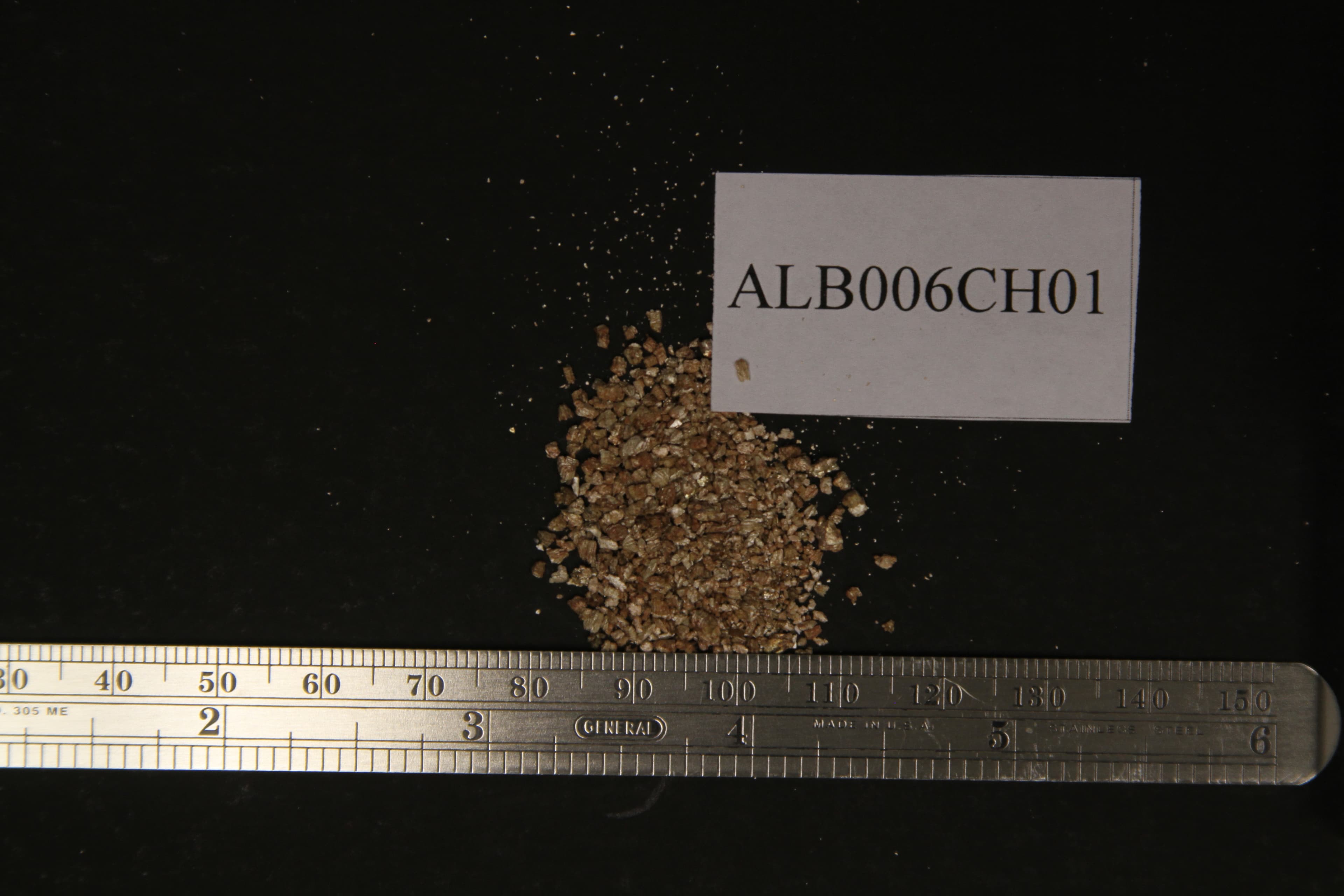
Sample photograph — USGS Spectral Library v7
Spectrum Details
- Modality
- NIR
- Category
- man-made
- Material Type
- Expanded Phyllosilicates
- Sample ID
- ALB006CH01
- Collection Locality
- This sample is from the Al Bush vermiculite collection housed at the U.S. Geological Survey in Denver. It apparently originates from Jiangsu, China based on the sample label.
- Spectral Purity
- 1b2_3_4_ # 1= 0.2-3, 2= 1.5-6, 3= 6-25, 4= 20-150 microns
- Composition / XRD
- None # XRF, EPMA, ICP(Trace), WChem
- Sample Description
- The sample has a red to golden color and its grains range in size from 0.5 - 3 mm (Fig. ALB006CH01.photo.1). Because of the limited volume of this sample ( The sample has a spectral signature similar to that of expanded vermiculite ore from Enoree, South Carolina, though its elemental composition is unique relative to the four others. Original spectrum published in: IMAGE_OF_SAMPLE:
- XRD Analysis
- Rietveld refinement XRD analysis (limited quantities of sample and no internal standard) of the bulk sample indicates major biotite and phlogopite, with minor vermiculite (Fig. ALB006CH01.XRD.2). It is worth noting that expansion of vermiculite may destroy long-range crystallographic order and that unexpandable phases like biotite and phlogopite may dominate in x-ray diffraction measurements in expanded vermiculite ore. Talc was sought but not found even after attempts to enhance the intensity of the {001} reflection (but it was successfully found by SEM/EDS). There may also be some montmorillonite, however, there was not enough sample for a clay separation to better substantiate its presence.
- X Units
- cm⁻¹
- Y Units
- Absorbance
- Data Points
- 2,126
Download
Attribution
USGS Spectral Library Version 7, U.S. Geological Survey
License: Public Domain
DOI: 10.3133/ds1035Analyze in Workbench
Open this spectrum in the SpectralBench workbench for advanced analysis, peak detection, and comparison.
Open Workbench