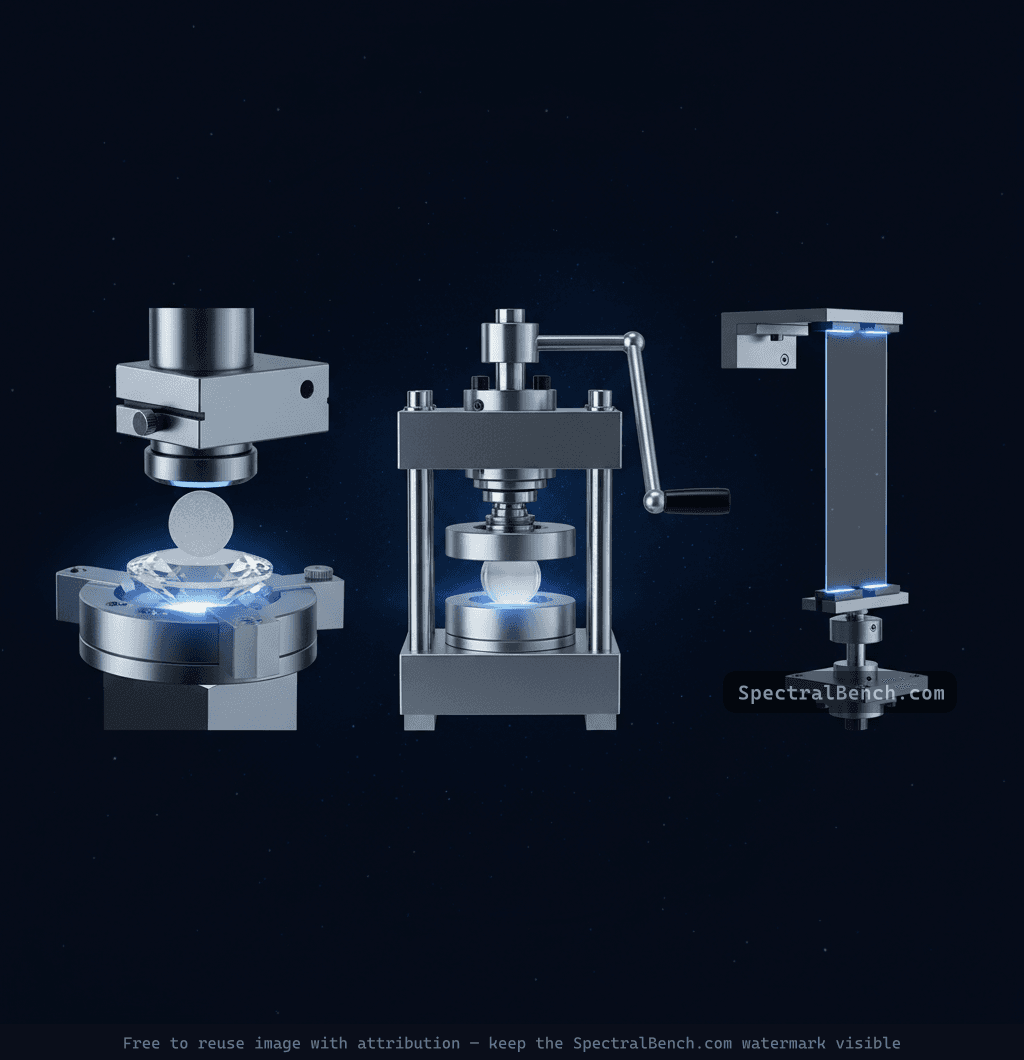
The quality of an FTIR spectrum depends almost entirely on how you prepare your sample. Poor preparation produces noisy baselines, distorted peaks, and unreliable identifications — no amount of post-processing will fix a bad measurement. This guide compares the three most common FTIR sample preparation methods and helps you choose the right one for your application.
ATR (Attenuated Total Reflectance)
ATR has become the default FTIR sampling technique in most laboratories. The sample is pressed against a crystal with a high refractive index — typically diamond, ZnSe, or germanium — and the infrared beam undergoes total internal reflection at the crystal-sample interface. The evanescent wave penetrates roughly 0.5–2 μm into the sample, producing an absorption spectrum without any additional preparation.
When to use ATR
- Solids, powders, liquids, gels, pastes — essentially any sample that can make physical contact with the crystal surface
- Quick screening and identification — place the sample, press, measure, clean, repeat
- Quality control workflows where throughput matters more than absolute sensitivity
- Aqueous solutions — water's strong IR absorption is manageable because the path length is inherently short
Crystal material selection
Diamond is the most versatile ATR crystal. It covers the full mid-IR range (4000–400 cm⁻¹), resists scratching, and tolerates aggressive solvents and acidic/basic samples. Diamond ATR is the standard choice for general-purpose work.
ZnSe (zinc selenide) offers higher sensitivity than diamond due to its larger refractive index mismatch, but it is softer and vulnerable to acids. Use ZnSe for delicate samples where maximum sensitivity is needed and the sample is chemically mild.
Germanium has the highest refractive index of the three, producing the shallowest penetration depth. This makes it ideal for surface-sensitive measurements and strongly absorbing materials like carbon-black-filled rubbers that would saturate with diamond or ZnSe.
Common ATR mistakes
Insufficient contact pressure. If the sample does not make firm, uniform contact with the crystal, the spectrum will be weak or noisy. Apply consistent pressure using the anvil or clamp mechanism — you should see the absorbance increase as you tighten.
Not cleaning between samples. Residual material on the crystal contaminates the next measurement. Clean with isopropanol and lint-free wipes between every sample. For stubborn residues, use an appropriate solvent for the contaminant.
Ignoring the ATR correction. ATR spectra have wavelength-dependent penetration depth — longer wavelengths penetrate deeper, producing relatively stronger absorbance at lower wavenumbers. Most software includes an ATR correction function that compensates for this effect and makes the spectrum directly comparable to transmission data.
You can upload and view your ATR spectra directly in SpectralBench, or compare them against the reference library for identification.
KBr Pellet (Transmission)
The KBr pellet technique has been the gold standard for FTIR since the 1950s. The sample is ground with dry potassium bromide powder (typically 1–2% sample by weight), and the mixture is pressed under high pressure (8–10 tons) to form a transparent disc. The infrared beam passes through the pellet, producing a transmission spectrum.
When to use KBr pellets
- Quantitative analysis where Beer-Lambert law linearity matters — the transmission geometry gives a well-defined, controllable path length
- Reference spectrum generation — most spectral libraries contain transmission spectra, so KBr data matches directly without ATR correction
- Trace analysis — you can increase the sample concentration in the pellet to boost weak absorptions
- Regulatory or pharmacopeia methods that specify transmission measurements (e.g., USP methods)
Pressing technique
- Dry the KBr — store in a desiccator and heat at 110°C for several hours before use. KBr is extremely hygroscopic; even brief exposure to humid air introduces water peaks near 3400 cm⁻¹ and 1640 cm⁻¹ that obscure sample features
- Grind to fine powder — use an agate mortar and pestle to grind the sample-KBr mixture to a particle size below the wavelength of mid-IR light (~2 μm). Coarse particles cause scattering, producing a sloped baseline and broadened peaks
- Mix uniformly — inadequate mixing produces concentration gradients across the pellet, causing irreproducible spectra
- Press at 8–10 tons for 2+ minutes — insufficient pressure produces cloudy, opaque pellets. The pellet should be transparent or slightly translucent when held up to light
- Measure promptly — KBr pellets absorb moisture from the air within minutes. Prepare and measure in rapid succession
Common KBr mistakes
Using wet KBr. This is the number one cause of poor KBr spectra. The broad O-H stretch around 3400 cm⁻¹ can completely mask N-H and O-H peaks from the sample. Always use freshly dried KBr.
Grinding too coarsely. Particles larger than the IR wavelength scatter light rather than transmitting it. The result is a sloped baseline that rises toward higher wavenumbers (the Christiansen effect). If your baseline slopes upward to the left, grind finer.
Overloading the pellet. Too much sample relative to KBr causes the strongest peaks to flatten or clip at the top — the detector saturates, and you lose quantitative accuracy. Aim for the strongest peak reaching 0.5–0.8 absorbance units.
Thin Film (Cast Film / Free-Standing Film)
Thin film preparation involves dissolving the sample in a volatile solvent, depositing the solution onto an IR-transparent window (KBr, NaCl, CaF₂, or BaF₂), and allowing the solvent to evaporate. The resulting film is measured in transmission.
When to use thin films
- Polymers and resins that dissolve in common solvents — cast films produce excellent spectra with uniform thickness
- Coatings and surface layers — measure the actual film as-deposited rather than scraping and grinding
- Organic compounds that are difficult to grind into KBr — dissolution bypasses mechanical preparation entirely
- Quantitative polymer analysis where film thickness can be controlled for reproducibility
Casting technique
- Choose the right solvent — the solvent must fully dissolve the sample and evaporate cleanly. Chloroform, dichloromethane, and THF are common choices. The solvent must not dissolve the window material
- Deposit evenly — use a micropipette to deposit a small volume (10–50 μL) onto the window center. Tilt the window gently to spread the solution, or use a spin coater for uniform thickness
- Evaporate slowly — rapid evaporation (e.g., blowing nitrogen) can trap solvent in the film, producing residual solvent peaks. Allow the film to dry in a fume hood at ambient temperature
- Check thickness — the ideal film produces the strongest absorption band at 0.3–0.7 absorbance units. Too thick and peaks saturate; too thin and the spectrum is noisy
Common thin film mistakes
Residual solvent. If the solvent does not fully evaporate, its peaks appear in the spectrum and may overlap with sample features. Chloroform leaves a characteristic C-H stretch near 3020 cm⁻¹. Verify complete evaporation by checking for solvent-specific peaks.
Non-uniform thickness. Thickness variation across the film causes fringing (sinusoidal baseline oscillation) and irreproducible peak intensities. Spin coating or careful manual spreading minimizes this.
Window incompatibility. NaCl and KBr windows are water-soluble — aqueous solvents destroy them. CaF₂ is more chemically resistant but has a lower wavenumber cutoff (~1000 cm⁻¹). Match the window material to your solvent and spectral range requirements.
Method comparison
| Criterion | ATR | KBr Pellet | Thin Film |
|---|---|---|---|
| Preparation time | Seconds | 15–30 minutes | 10–60 minutes |
| Sample types | Nearly universal | Solids, powders | Soluble materials |
| Quantitative accuracy | Moderate | High | High |
| Sensitivity | Moderate | High (adjustable) | High (adjustable) |
| Destructive? | Usually no | Yes (ground) | Yes (dissolved) |
| Skill level | Beginner | Intermediate | Intermediate |
| Library matching | Needs ATR correction | Direct match | Direct match |
Choosing the right method
For routine identification and screening, start with ATR. It requires the least preparation, works with almost any sample, and produces results in under a minute. Most modern FTIR peak databases include ATR-corrected reference spectra.
For quantitative work, pharmacopeial methods, or when building reference libraries, use KBr pellets. The controlled path length and direct transmission geometry give the most reproducible, Beer-Lambert-compliant spectra.
For polymers, coatings, or samples that dissolve easily, use thin films. Cast films give excellent spectral quality with minimal artifact, and the technique scales well for systematic studies where many samples of the same material type need consistent preparation.
Whatever method you choose, always run a background spectrum immediately before your sample measurement, and verify your spectral data quality against known reference spectra in SpectralBench.